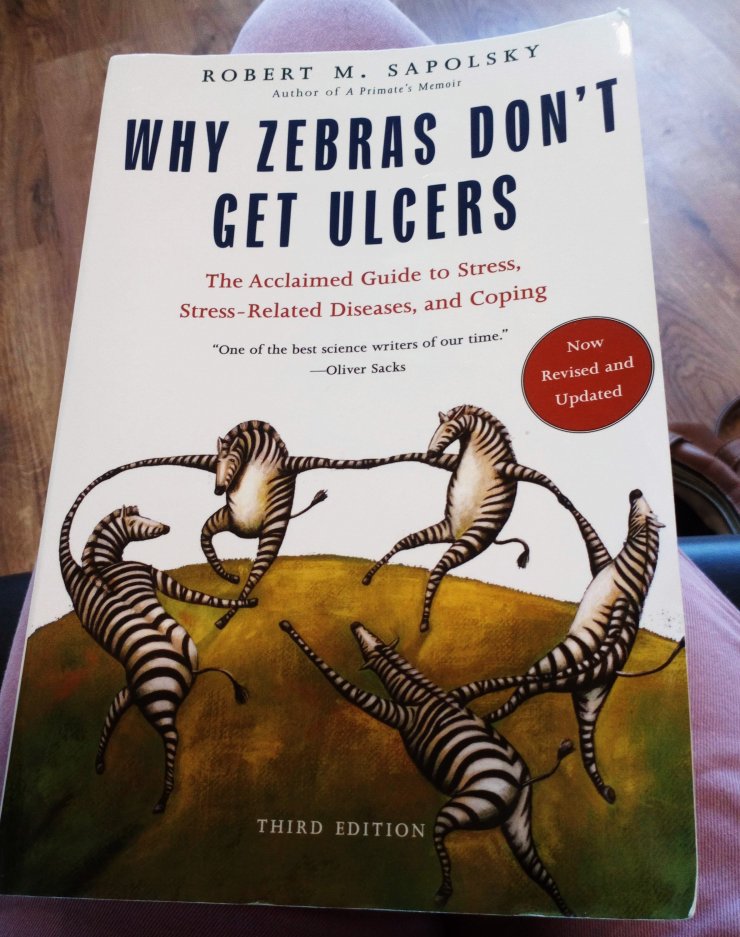
Stress. We’ve all had it. We all have it in varying degrees to one another, but what is it really doing to our health? In my search for answers I stumbled across this fantastic book in my reflexology clinic and immediately became hooked: Why Zebras Don’t get Ulcers by Robert M. Sapolsky, neuroendocrinologist and professor at Stanford University.
We often assume stress is a modern-day right of passage, so to speak, or that it’s an unavoidable part of life we just have to put up with. And often if you are stressed (using working at a high-stress job as an example) you may even feel like you’re getting somewhere: you can buy more things, accumulate more possessions. Initially it feels good to work hard. It gives you a sense of accomplishment.
But does the hard work ever pay off?
Do you feel satisfied when you’ve reached your goal? Or are you now on to the next goal with even more responsibility and pressure on your shoulders? You may get a pay rise (lovely) but you’re now working longer hours with more accountability. Your relationships become strained, your home life suffering; you feel like you’re on a never-ending, uphill treadmill but the promise of a Utopian ending (early retirement) hangs in the back of your mind so you stick at it. Then suddenly, your health declines.
So whats the problem?
Human beings were not designed to live in a chronic stressed state. Collectively our lives are completely unbalanced, with long working hours (or no working hours in the case of unemployment which can be as equally devastating to a person’s emotional and physical well-being) perhaps in a job that a person dreads going to creating anxiety and unease. Many jobs now also involve sitting unnaturally at a desk for long periods of time with primary interaction being with a computer monitor and not another human being. In the education and health sectors, which, fundamentally, should be based on direct human interaction and communication, it’s becoming increasingly more demanding and difficult to fulfil these principles due to chronic staff shortages and less funding to rectify it.
Little time or money is invested on personal development and growth outside of the work place and it’s even deemed as a bit self-indulgent if you pursue such endeavours. Cost of living has increased and the ability to own your own home is increasingly more difficult. The quality of our food has diminished in the last few decades and the exposure to chemicals through household cleaners, medicines, water and products we use on a daily basis leave our immune systems burdened to the tipping point (we are already seeing a mass increase in antibiotic-resistant infectious diseases due to antibiotic overuse in the medical industry and agriculture). Throw a few kids in the mix and you’ve now got to deal with the enormous weight of parental responsibilities, financial worries, student debts, zero-hour contracts, negative social media influences, lack of quality sleep and no time to pursue meaningful and personal interests away from home/work life… Is it any wonder the majority of our population is STRESSED?!
Headaches start, indigestion and IBS follows. Chronic nausea might really bug you at varying times of the day so you wrack your brains trying to figure out what food is constantly setting you off. Irritability, depression and anxiety become your ‘norm’. Low energy and anger outbursts (adrenal fatigue) become a daily occurrence. Weight gain and hair loss may start (thyroid dysfunctions). Cystic acne and excess hair around the chin and jawline may develop (hormonal imbalance/ excess androgen production in response to stress)…
Sound familiar?
As Robert M. Sapolsky explains in his book Why Zebras Don’t Get Ulcers, this type of chronic, low-grade stress is as devastating – if not more so – to the body as one-off, highly stressful life events. Think of a zebra happily munching away on some fresh grass he’s found in the middle of an African plane. All he thinks about is how nice the grass is, how glad he is to get it, and where he might mosey off to next (pursue the ladies maybe? Go find some water? etc.) Suddenly, a huge lion leaps from the undergrowth with one thing on his mind: to eat that zebra. Now, the zebra knows this (as it’s most likely happened before) so within seconds, his sympathetic nervous system is activated and fired off, his body is flooded with hormones like glucocorticoids, noradrenaline, adrenaline and cortisol and all the oxygen rich blood in his circulatory system is pumping fast while furiously diverting to his heart and extremities (legs) to enable him to get the hell out of there; to survive.
The zebra runs away; the lion – having decided the zebra just isn’t worth the exertion – calls off the chase. After a few tense minutes the zebra slows down, realises the lion is no longer pursuing him and his heart rate returns to normal, or, to it’s ‘pre-chase’ state. Parasympathetic activation has resumed allowing that lovely oxygen rich blood to flow back into the digestive system and other organs. Hormone secretion slows, internal equilibrium and balance are restored. The zebra, meanwhile, goes back to munching on his grass as though nothing as happened.
The above mentioned hormones are exceptionally good at kick starting your survival instincts in the face of extreme danger. What they aren’t designed to do, however, is to be secreted day-in, day-out by someone sitting frustrated at an office desk ready to blow a fuse (which they subsequently don’t do considering that would likely freak out their colleagues). The sympathetic nervous system has been steadily activated all day and so therefore the tired, frustrated and irritable worker goes home, has a massive argument over something trivial with a dear loved one or immediately cracks open a bottle of wine as a release. Over time, stress-response hormones float around the body, building in volume and wreaking havoc on the rest of the body’s systems. Balance never gets restored, equilibrium never achieved.
So what can be done about it?
Stress is too huge a topic to condense into a single post so it might be beneficial for those interested to find follow-up posts on the effects of stress on specific parts of the body’s systems. These will also include some helpful suggestions about how to naturally manage stress at home!
UP NEXT: Stress vs. Digestion – Who wins?
** Disclaimer: These posts are based on personal opinion and research only. They are not intended to be taken as medical advice. Any ongoing or new health concerns should always be brought to the attention of a qualified health care professional.
 Reflexology Letterkenny